
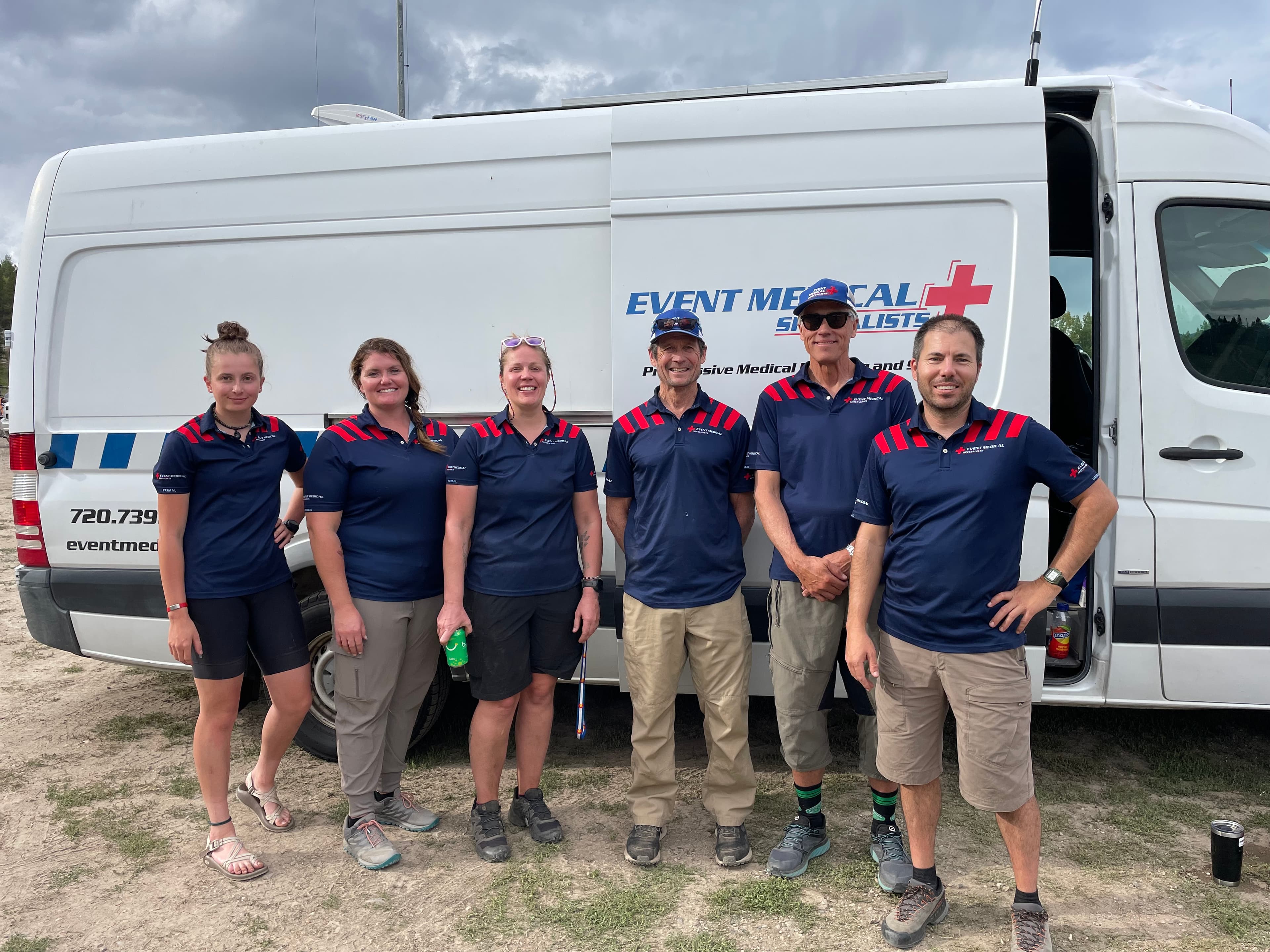
There's a common instinct when planning medical coverage for a technical outdoor event: put your people at the dangerous spots — the steep downhill, the sharp switchback. For a while, that's how we thought about it too. It turns out that instinct is incomplete, and leaning on it too hard leaves large stretches of your course dangerously uncovered.
Start With Response Time
Before headcount or placement, the first question is: how fast do you need to respond? In rural communities — where most endurance events happen — a 10–30 minute 911 response is not unusual. That gap is exactly why onsite coverage exists. Our working target for Colorado courses up to six miles is 2–8 minutes for 90% of incidents, measured from coordinator notification to provider contact. If your staff can't meaningfully outperform local 911, you haven't justified the expense.
Get this conversation with the event promoter on the table early. An honest coordinator should be clear about what's achievable — and what isn't — at a given resource level.
The Overlay Method: Time-Based Spacing
Most people default to distance-based thinking — space providers every mile or two. That's the wrong unit. The right unit is time. A punishing 400-foot climb takes longer than a flat half-mile even if the map distance looks identical. Providers on bikes or QRVs (Quick Response Vehicles — an SUV or other vehicle appropriate for the terrain; UTVs can be used where allowed by the property manager) have very different spacing math than providers on foot.
Think of your providers as a layer placed over the course map. Shift that layer until spacing between providers is as even as possible on a time basis. Then keep adjusting until that evenly-spaced layer also aligns with the known high-risk sections. With the right spacing, you often achieve even coverage and risk-weighted coverage simultaneously — the two goals reinforce each other rather than compete.
On a ten-mile course with four providers, one anchors the medical tent. The other three space out by travel time, then adjust forward and back until they're also near the high-risk sections.
The Nonlinear Benefit of Spreading Out
The benefit of separating providers is nonlinear. Pull two providers apart from a shared post to opposite ends of their section and you might not halve average response time — you might cut it to a third. The closer providers are to each other, the worse the system performs on average.
This creates a culture question. When one provider has a call, we will often let them handle it independently rather than pulling coverage from another section. That decision is both operationally correct and developmentally correct — a provider who handles a challenging call alone walks away more capable. Complex trauma and life threats get backup. A typical musculoskeletal or medical incident does not.
If I send backup to every call, its not best to the rest of the course that's now short a set of hands and eyes.
This philosophy demands careful hiring. A lean system only works if your providers can genuinely operate independently: sound decisions, managing bystanders, delegating to course marshals, and calling for backup when — and only when — it's truly needed.
Don't Underestimate the Unremarkable Sections
Medical incidents — hypoglycemia, exertional asthma, heat illness, cardiac events — don't care about trail difficulty. They happen on long climbs and flat fire roads. Even crashes were harder to predict by terrain type than we expected; athletes crash when they're tired or pushing pace, not always where the course is hardest. If you overweight technical sections and leave stretches of "boring" course uncovered, you will eventually have a serious incident in that gap.
Level of Care in the Field
A provider's certification and their effectiveness in a pre-hospital environment aren't always the same thing. A physician without proper equipment or emergency medicine experience may perform closer to a Basic provider in the field than their credential implies. Structure staffing accordingly.
Physician (ED / Sports Med) — When their training and experience are right, physicians can add that last 10% of capability that makes a difference in special circumstances.
PA or RN (ED-experienced) — ALS. Emergency experience is the qualifier, not the credential alone.
Paramedic — ALS, or BLS if correct equipment is absent, though they offer more experience.
EMT — The workhorse for course coverage with a broad scope of practice in Colorado.
Wilderness First Responder or First Aid— Well-suited to remote environments.
When the surrounding 911 system is BLS only, the onsite system should reach ALS level. If ambulance response exceeds 10 minutes and no dedicated onsite ambulance is present, that argument strengthens considerably. EMTs and paramedics operate under medical direction — they are physician extenders. Document the medical director relationship clearly before event day.
Access, Evacuation, and Communication
Map your farthest-point scenario explicitly — where on the course would an incident carry the longest response time? Evacuation routing runs in priority order from off-course (least disruptive) to on-course with traffic, to on-course against traffic as a last resort. Identify helicopter landing zones and ground ambulance access points in advance. Courses with multiple vehicle access points will serve critical patients better; evacuation times drop and resources return to availability faster.
Communication is the nervous system of your medical response. Position course marshals where they can observe significant course segments — a crash no marshal sees adds critical minutes when riders have to carry the notification forward. Use a unified radio system across all distributed staff; mixing radio systems creates gaps at the worst moments. Treat cell coverage as a backup only, not a plan.
Professionals, Volunteers, and the Mix
Good Samaritan laws typically cover people who happen upon an emergency — not providers who agreed in advance to render event coverage. That agreement creates a Duty to Act, which puts volunteers in legal gray area if they fail to respond appropriately. The stronger argument for professional staffing is consistency: common training, common equipment, common language under pressure. Our working ratio in Colorado is roughly four professionals to one volunteer. "Professional" here means trained, equipped, and accountable — not necessarily paid. Search and rescue teams and medical corps can provide in-kind professional-level coverage that fits a tighter budget without sacrificing reliability.
The events that go smoothly — even when something serious happens — are the ones where the system was designed with intention before anyone arrived on site. The terrain is technical, the geography is large, and the athletes are pushing their limits. Build your medical system for all three of those realities at once.